I Thought Better Cholesterol and Blood Pressure Numbers Meant Everything Was Moving in the Right Direction. Then One Question Made Me Reconsider That.
A man in his late 50s had improved the numbers everyone watches — so why did he still feel like something was wrong?

By Ava Morgan — Cardiovascular Health Researcher
As told to Healthletic · July 2026 · 11 min read
I remember the question because it was so simple.
And I didn't have a good answer.
A man in his late 50s was telling me about his latest checkup.
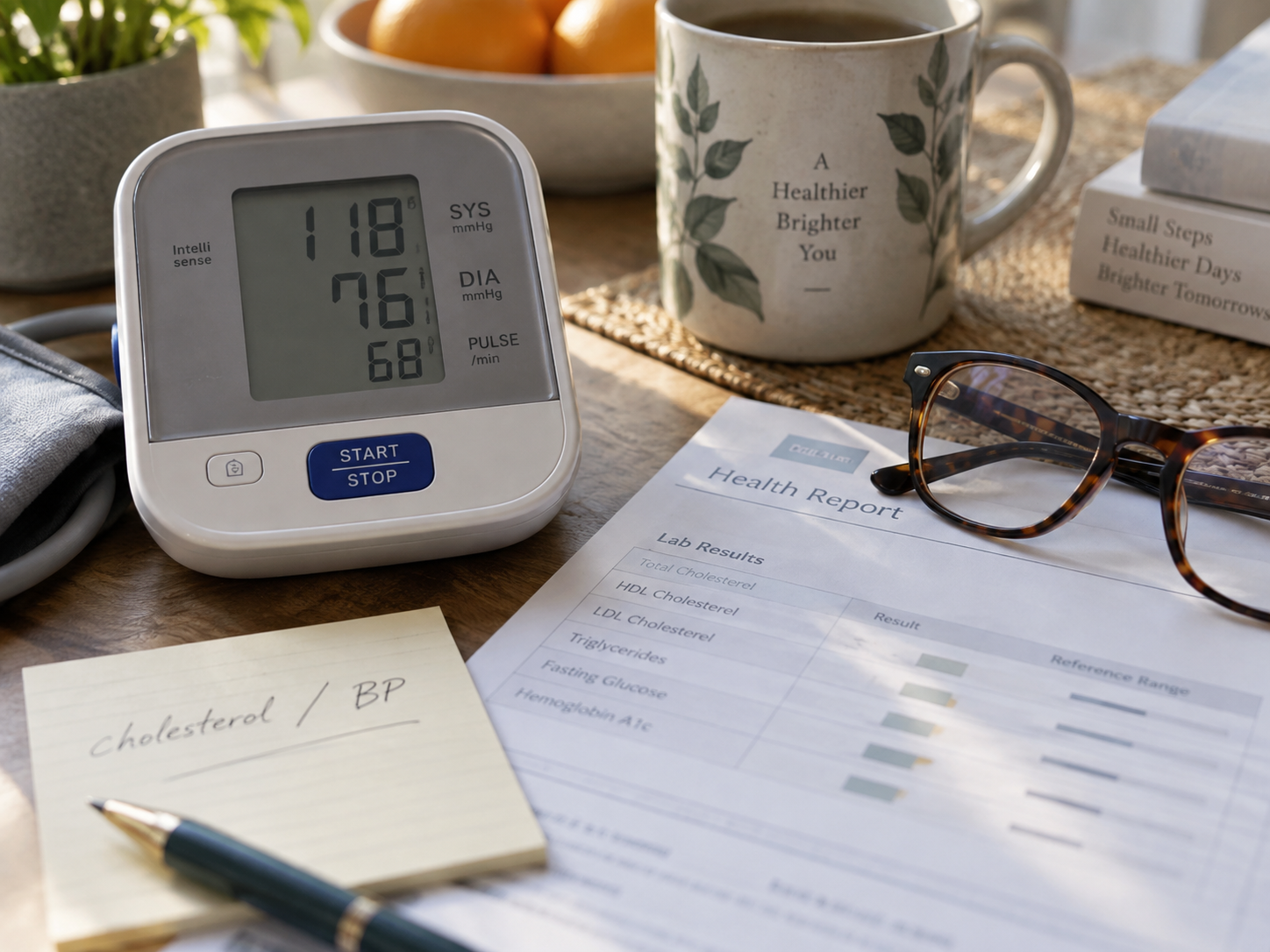
His cholesterol was down.
His blood pressure looked better than it had in years.
On paper, things seemed to be moving in the right direction.
But then he looked at me and said:
“So why do I still feel like I'm getting worse?”
His hands were constantly cold.
His legs felt heavy by the end of the day.
Walking upstairs left him more winded than it used to.
His energy disappeared every afternoon.
And despite doing what he'd been told to do, he couldn't shake the feeling that something was still off.
That conversation stuck with me.
Because I'd heard different versions of it again and again.
People focused intensely on two numbers:
Blood pressure. Cholesterol.
And those numbers absolutely matter.
But I eventually started wondering whether we were looking at only part of the picture.
“If My Numbers Are Better, Why Don't I Feel Better?”

That's the question I couldn't stop thinking about.
Because when most people think about cardiovascular health, they think about their lab report.
LDL.
HDL.
Blood pressure.
Maybe triglycerides.
And naturally, that's where most of the conversation goes.
But circulation is a living system.
Your blood has to move efficiently through thousands of miles of blood vessels every day.
It has to carry oxygen and nutrients to your muscles, brain, hands, feet and every other tissue in your body.
And your body also has to constantly maintain a delicate balance between forming clots when they're needed…
…and breaking down clotting material when its job is finished.
That's when I came across a word I hadn't paid nearly enough attention to before:
Fibrin.
Fibrin isn't inherently bad.
In fact, you need it.
When you're injured, your body uses fibrin as part of the clotting process that helps stop bleeding.
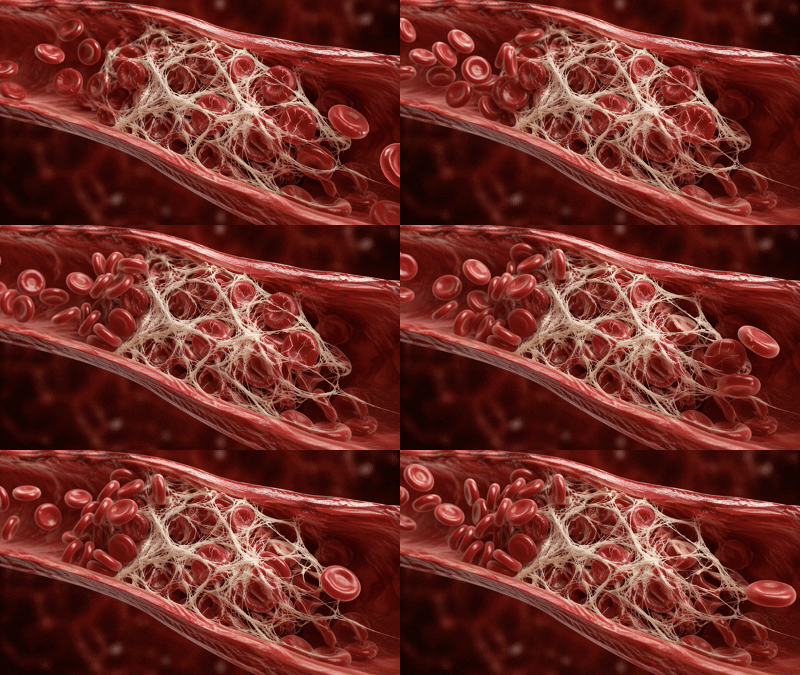
Think of it almost like a temporary repair net.
There's damage.
Your body sends in the repair material.
Fibrin helps create the mesh that stabilizes the area.
Exactly what you want.
But there's another side to the process.
Once fibrin has done its job, your body also has mechanisms designed to break it down.
That process is called fibrinolysis.
Formation.
Cleanup.
Formation.
Cleanup.
A constant balancing act.
And once I understood that, I started looking at cardiovascular health differently.
The Numbers Weren't the Whole Story.
That was the shift for me.
Blood pressure and cholesterol didn't suddenly become irrelevant.
Far from it.
But I realized there was another conversation worth having:
How well is the body's normal fibrin-management system functioning?
Fibrin doesn't just disappear on its own once it's done its job.
Your body has to actively break it down through a process called fibrinolysis, using enzymes that help dismantle the fibrin mesh.
And if that cleanup process becomes less efficient, fibrin can remain in place longer than intended.
That's what made me realize there was more to the picture than simply looking at cholesterol and blood pressure numbers.
Because circulation isn't simply about what your cholesterol number says.
It's about how efficiently blood moves through your vascular system.
Suddenly, a lot of complaints I'd heard over the years started making more sense as part of the same larger picture.
Cold hands and feet.
That heavy-leg feeling after a long day.
Feeling sluggish.
Feeling like your stamina isn't what it used to be.
The sense that your cardiovascular health is changing even though you're doing everything you're supposed to do.
I wanted to understand the biology behind it.
And that's what sent me down a research rabbit hole.
Then I Kept Running Into a Strange Japanese Food
Not a drug.
Not a new medical device.
Not some futuristic treatment.
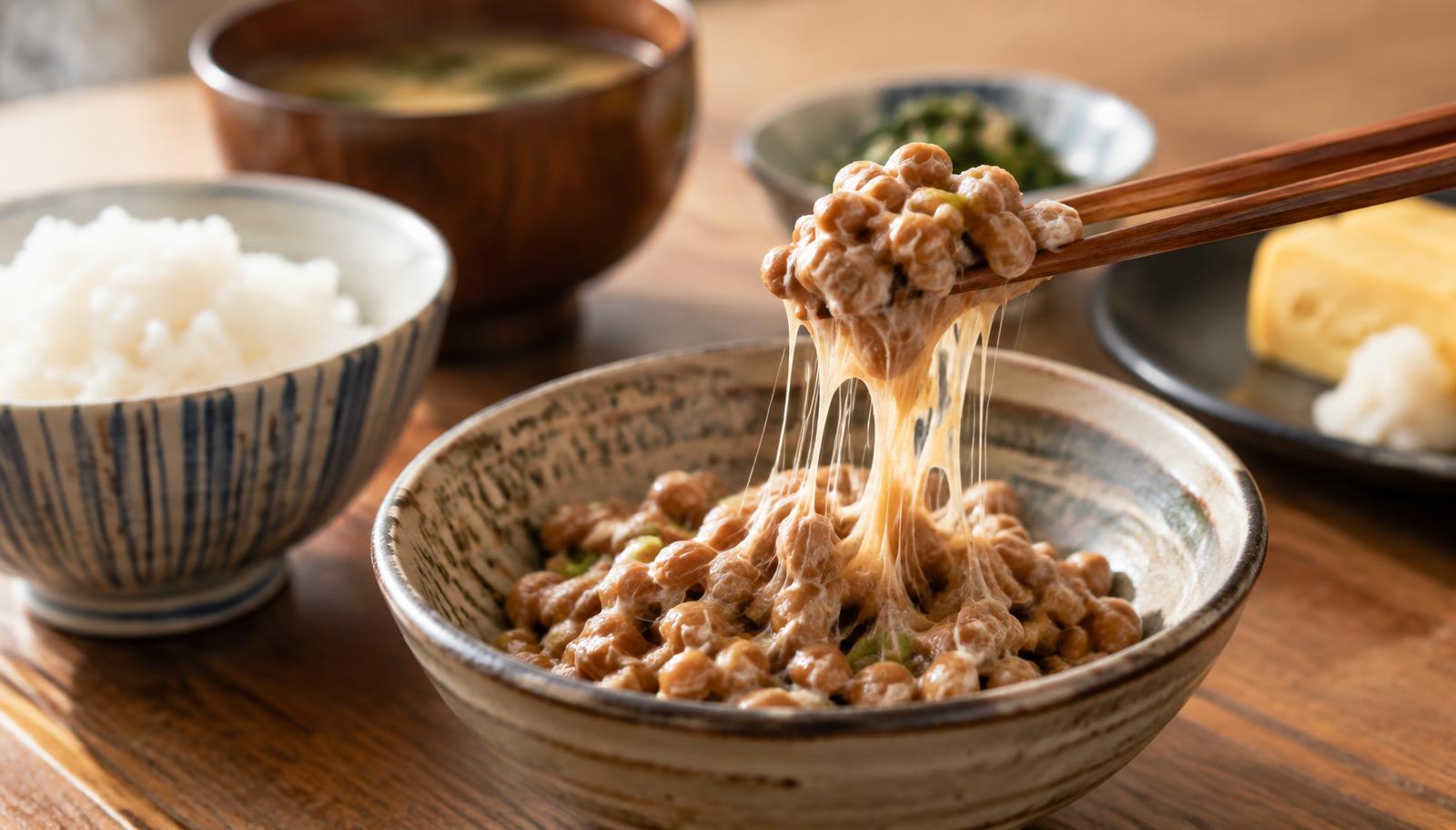
A sticky Japanese breakfast food called natto.
Natto is made from fermented soybeans.
It's been eaten in Japan for generations.
And frankly, if you've ever seen it, you probably wouldn't guess there was anything particularly interesting hiding inside it.
It has a famously strong smell.
A sticky texture.
And it's definitely an acquired taste.
But researchers became interested in something produced during its fermentation.
An enzyme called:
Nattokinase.
My first reaction was probably the same one most people have.
An enzyme from fermented soybeans?
Really?
That sounded almost too simple.
But I kept reading.
And one characteristic kept appearing again and again:
Nattokinase has fibrinolytic activity.
In plain English:
Researchers have studied its relationship with the body's fibrin and clotting systems.
A small placebo-controlled study found measurable changes in several coagulation and fibrinolysis markers after a single 2,000-FU dose. Another human study reported reductions in fibrinogen and several coagulation factors after regular nattokinase use.
Now I was paying attention.
Because this wasn't another ingredient being marketed simply as:
“Good for your heart.”
There was an actual biological mechanism worth investigating.
Then I Found Something Else That Surprised Me
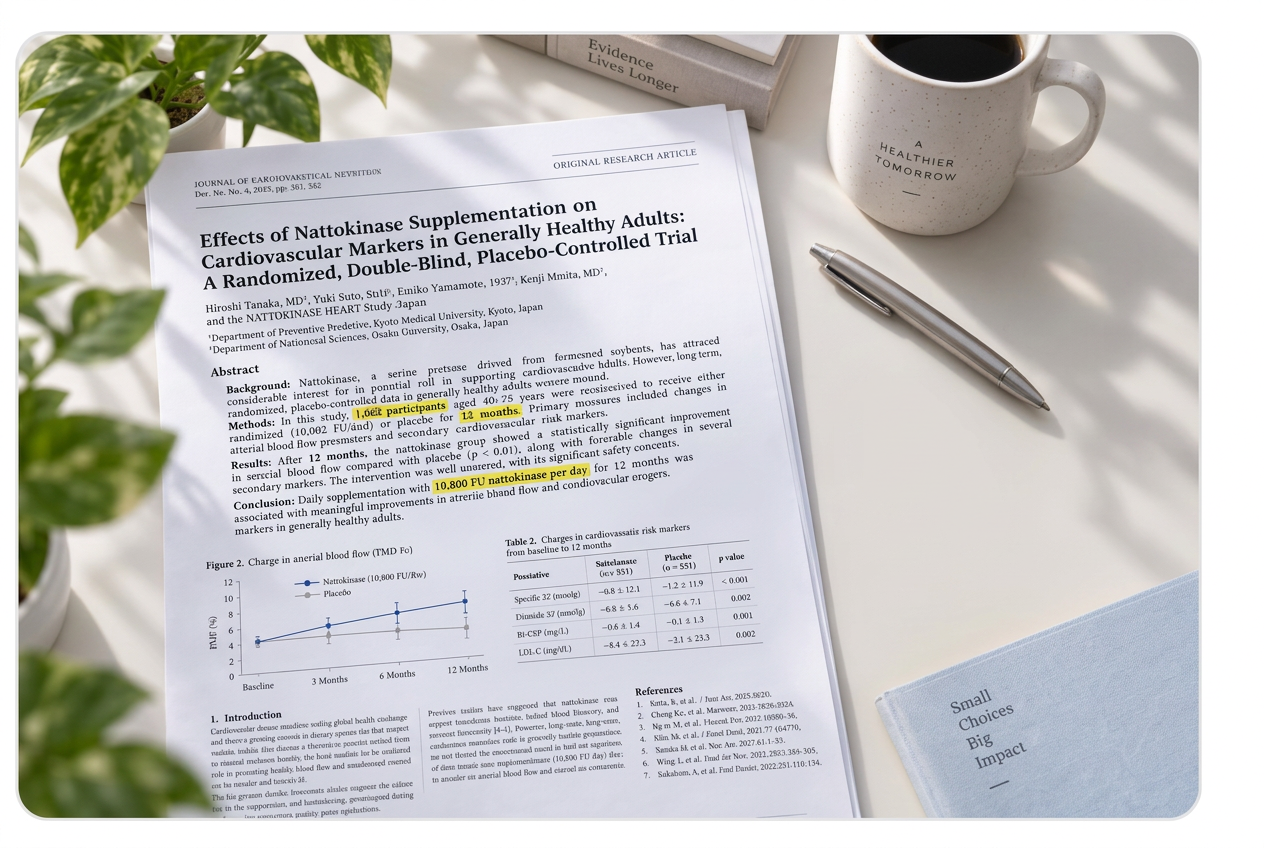
Nattokinase research wasn't limited to laboratory experiments.
There were human studies too.
One randomized, double-blind trial involving adults with elevated blood pressure found that nattokinase consumption was associated with reductions in systolic and diastolic blood pressure over eight weeks.
But the research wasn't uniformly positive.
And that part actually made the story more interesting.
A longer randomized trial gave participants 2,000 FU per day for roughly three years.
The researchers found no significant improvement in subclinical atherosclerosis progression, blood pressure, or the measured laboratory markers compared with placebo.
At first glance, you might think:
Well, that's that. Nattokinase doesn't do much.
Except then I found another study.
And this one made me look at every nattokinase bottle completely differently.
Six Bottles, Six Very Different Numbers
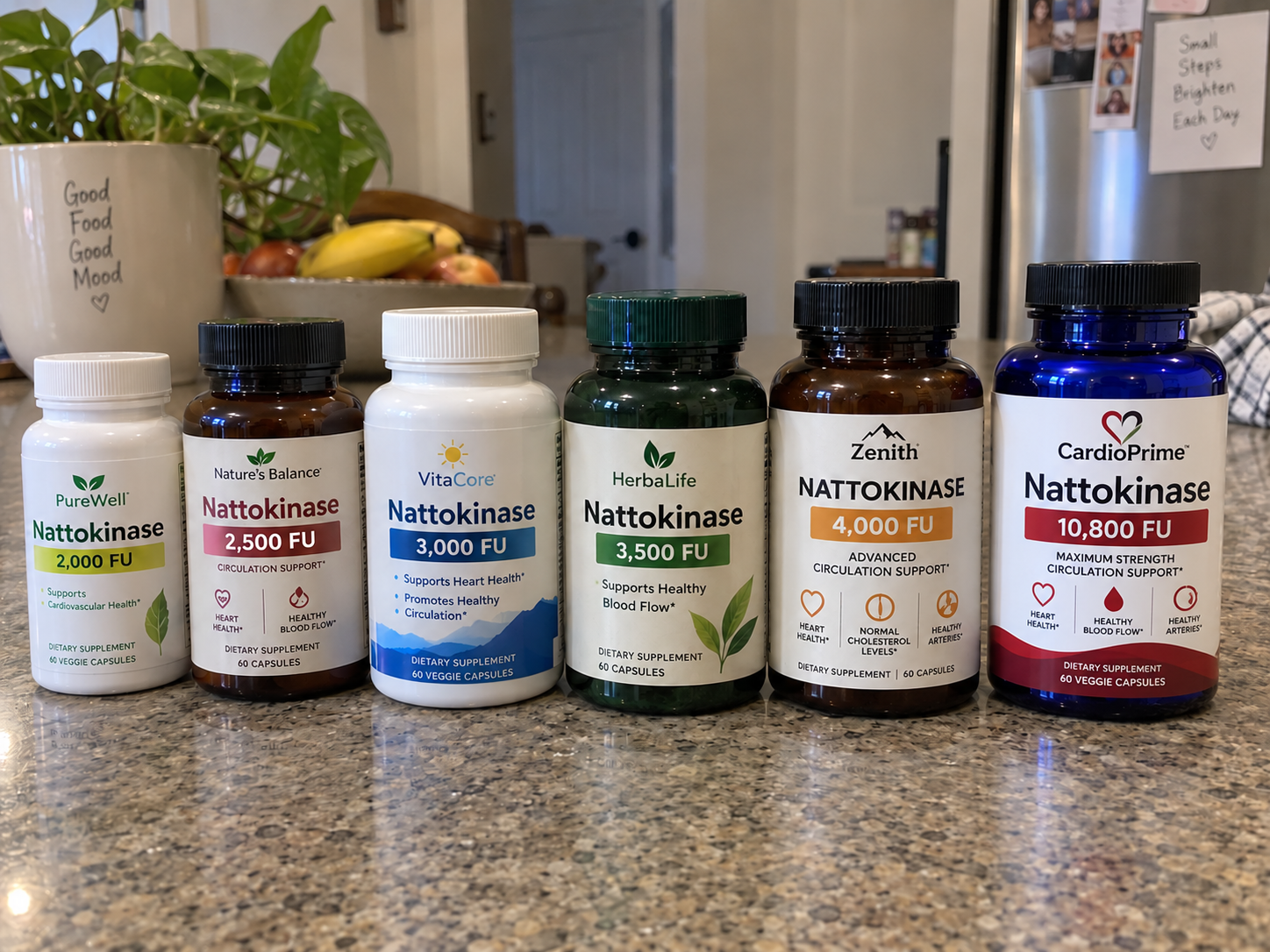
Those numbers matter because nattokinase isn't normally measured simply in milligrams.
Its activity is measured in FU — fibrinolytic units.
And most nattokinase supplements I saw were surprisingly low.
2,000 FU.
Maybe 4,000 FU.
That seemed to be the standard.
But a 2022 clinical study involving 1,062 participants examined a much higher daily intake:
10,800 FU.
After 12 months, researchers reported significant changes in lipid measures, carotid intima-media thickness and plaque size in the group using 10,800 FU.
The same paper reported that 3,600 FU per day did not produce the same effects.
That stopped me.
Because suddenly I wasn't asking:
“Does nattokinase work?”
I was asking a much more useful question:
“How much nattokinase activity are you actually getting?”
It's like comparing two flashlights.
They may both technically be flashlights.
But one gives off enough light to illuminate a room.
The other barely lets you see your shoes.
The label can say the same ingredient.
That doesn't mean you're getting the same level of activity.
But Please Don't Make the Mistake I Nearly Made

Don't see the word “nattokinase” on a bottle and assume every formula is equivalent.
Look at the FU activity.
Look at the serving.
Look at the testing.
Look at how it's formulated.
That's the lesson that changed the way I looked at it.
For me, those details make far more sense than choosing a product simply because it says “extra strength” on the front.
That's When I Started Looking at Bottles Differently
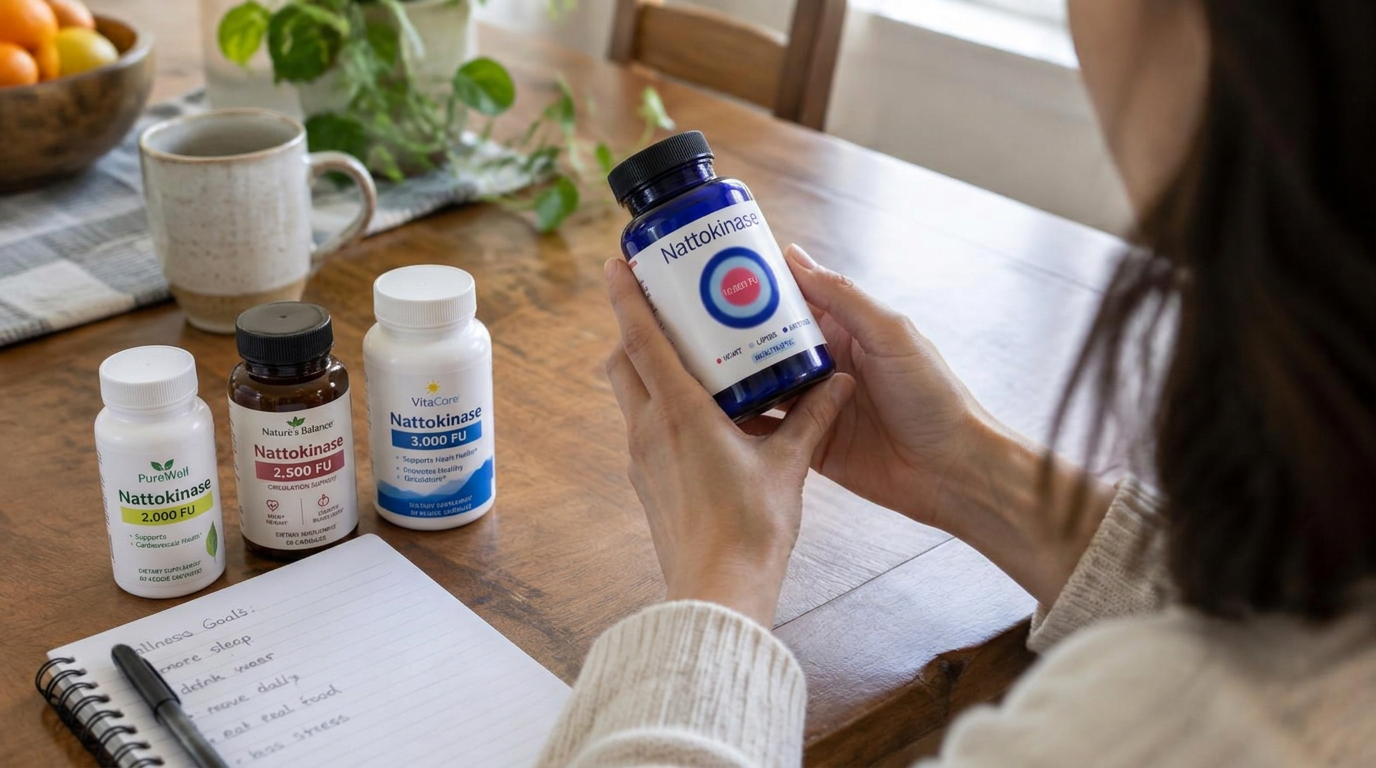
Once I knew what FU meant, I started checking labels.
2,000 FU.
2,000 FU.
4,000 FU.
2,000 FU.
Over and over.
And that created a new problem.
Even if I wanted to use nattokinase, I didn't simply want a bottle with the word “nattokinase” printed on the front.
I wanted to know:
How much active enzyme is actually there?
Has the potency been independently verified?
Is the formula designed to protect an enzyme through digestion?
What else is in the capsule?
And most importantly:
Does the daily serving actually resemble the higher dose used in published human research?
That's what eventually brought me to a formula called:
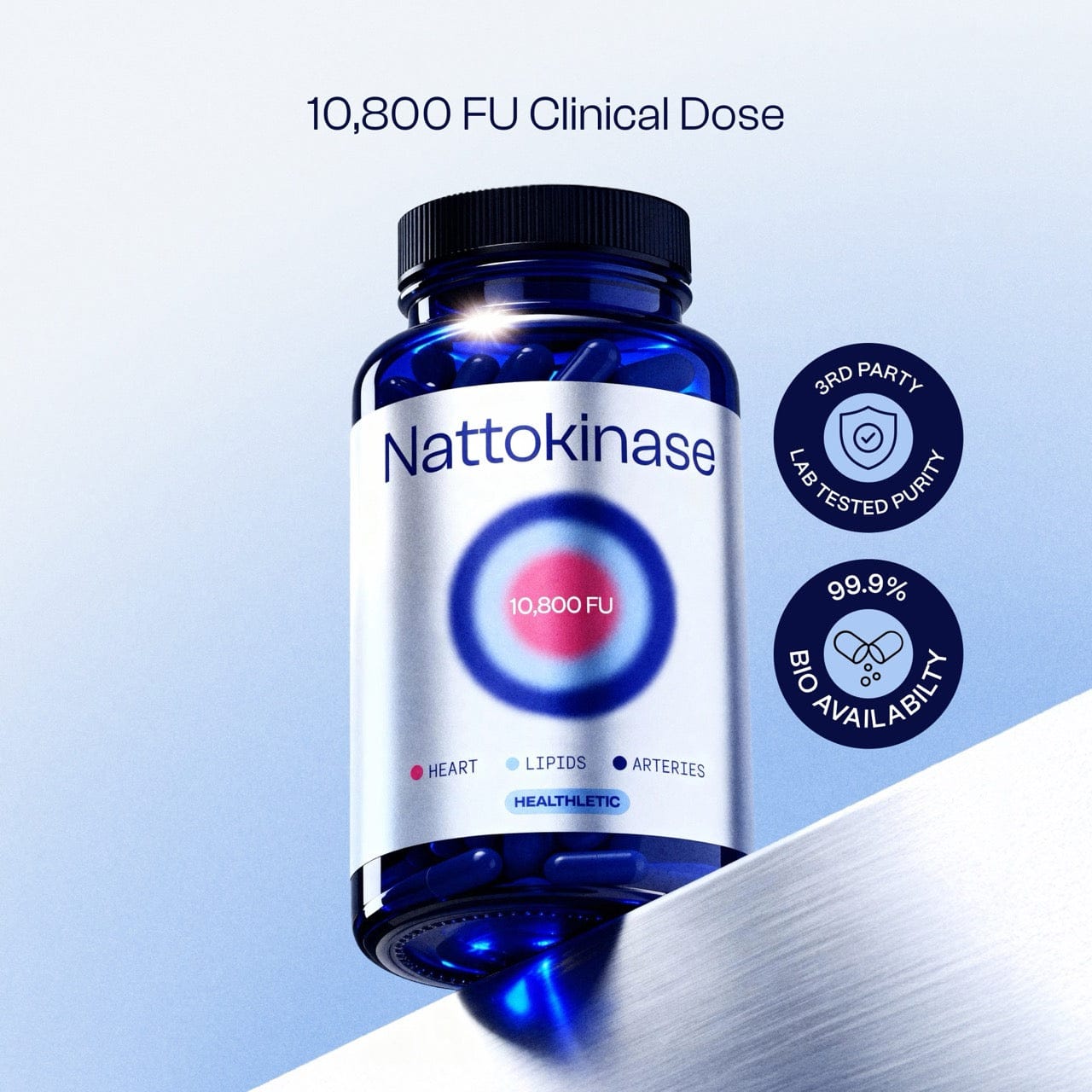
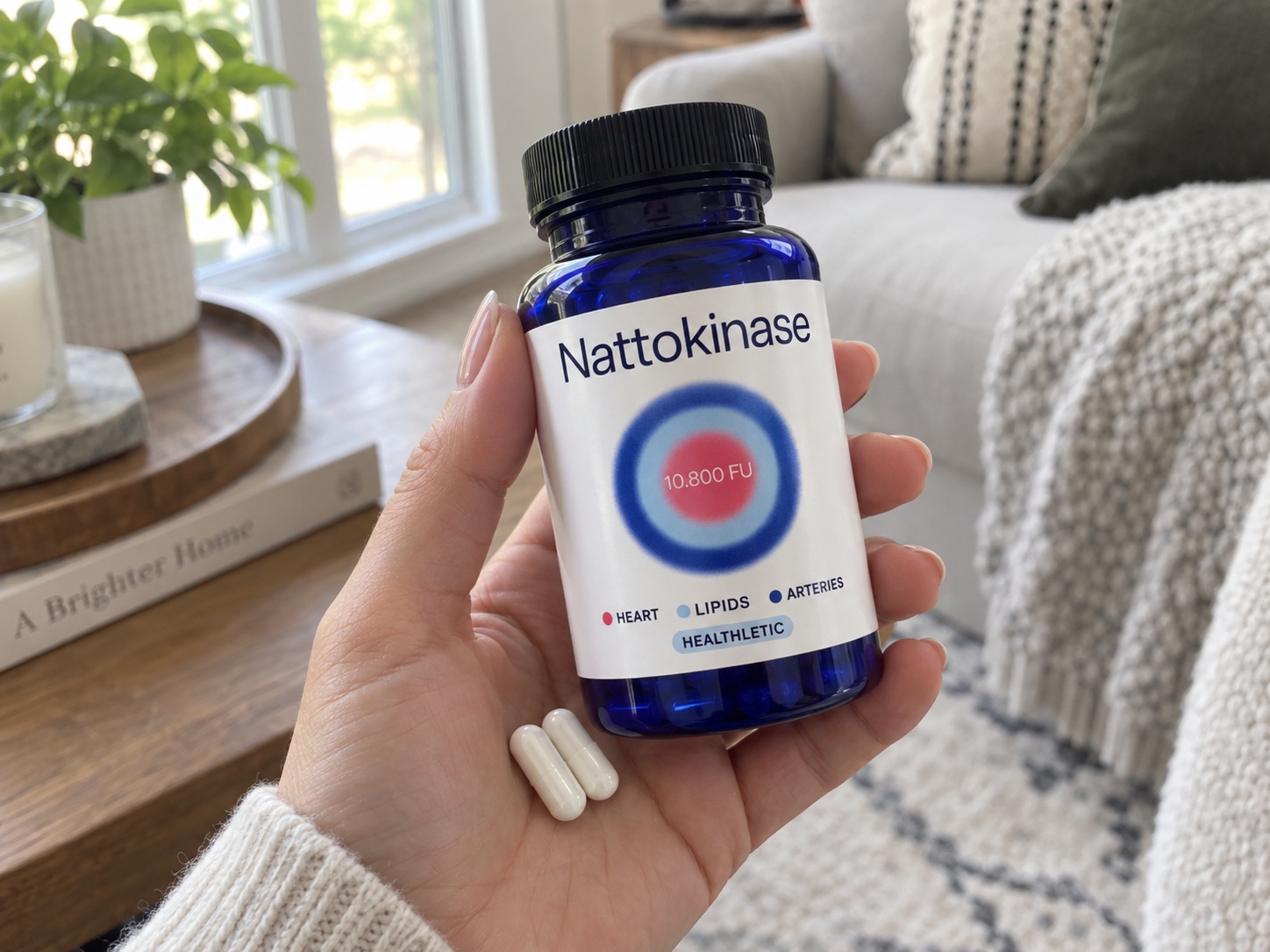
Healthletic Ultimate Nattokinase.
I'd already become interested in nattokinase itself.
Healthletic got my attention for a different reason.
The daily serving provides:
10,800 FU.
Not 2,000.
Not 4,000.
10,800 FU.
That's more than five times the activity of a typical 2,000-FU formula and corresponds with the higher intake examined in the 1,062-participant study.
But dose wasn't the only thing I looked at.
Healthletic says every batch is independently tested by an ISO-17025-accredited U.S. laboratory for FU potency, heavy metals and microbial safety, with certificates of analysis available on request.
The capsules are also delayed-release, designed to carry the enzyme through the stomach before releasing it farther down the digestive tract.
Those were the kinds of formulation details I wanted to see.
Not a prettier bottle.
Not louder marketing.
Actual reasons for choosing one nattokinase product over another.
That Was Enough for Me to Give It a Fair Try
By then, I'd already done the research.
I knew what I was looking for, and Healthletic matched the criteria I'd decided mattered to me.
So I stopped comparing bottle after bottle and decided to give it a fair try.
And knowing there was a 60-day money-back guarantee made that decision easier.
I didn't have to decide on day one whether it deserved a permanent place in my routine.
I could try it for myself, see what I thought, and make up my own mind.
If it wasn't for me, I had the option to get my money back.
That felt like a pretty reasonable way to find out.
So I Added It to My Morning Routine
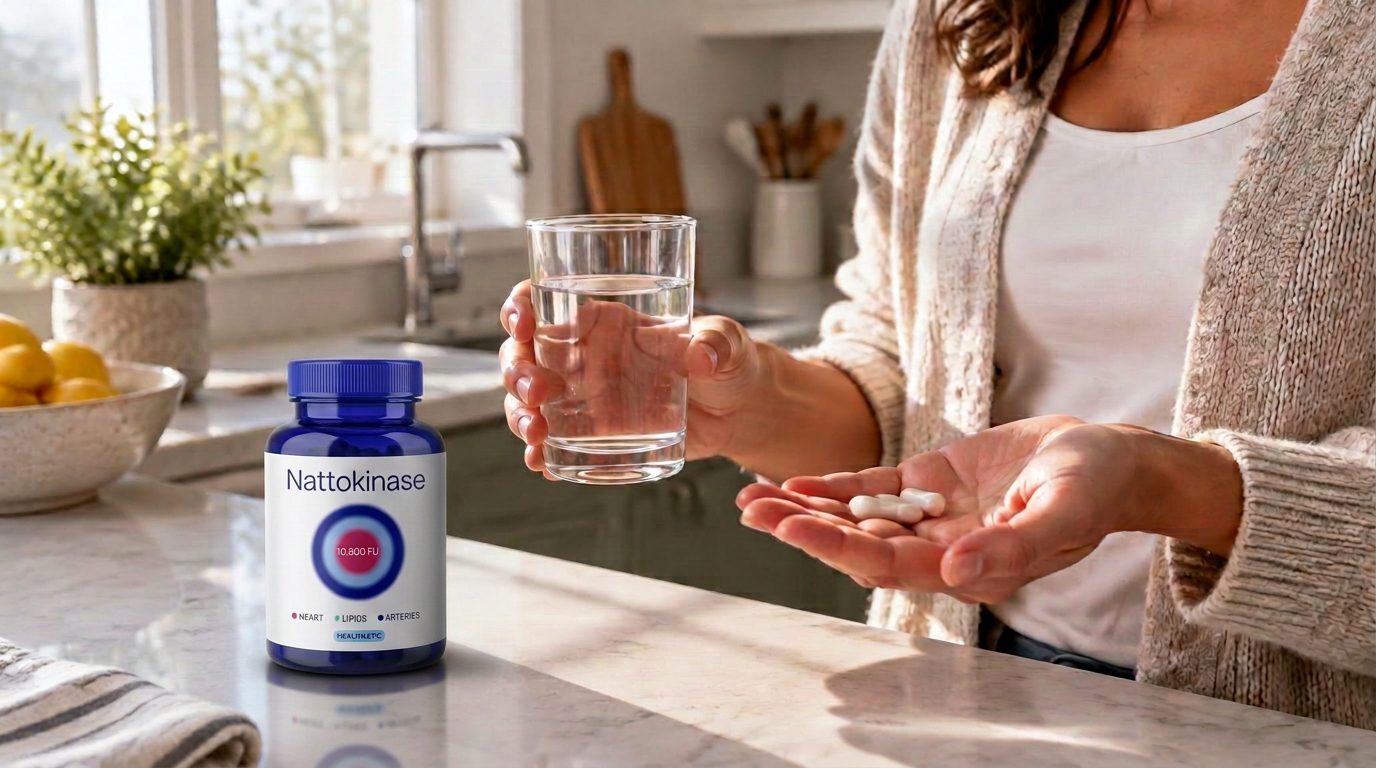
There wasn't anything dramatic about it.
No complicated protocol.
No strange drink.
No unpleasant natto taste.
Just two capsules.
Water.
Then on with my morning.
And I think this is important:
I wasn't expecting an overnight miracle.
In fact, that's one of the reasons I distrust products that promise you'll “feel it” immediately.
Cardiovascular health isn't a light switch.
The published 10,800-FU study followed participants for 12 months, not three days.
So I treated nattokinase like what it is:
A daily nutritional routine.
Not an emergency treatment.
Not a replacement for exercise.
Not a replacement for a good diet.
And absolutely not a reason to stop prescribed medication.
It simply became another part of how I thought about supporting healthy circulation.
Morning. Water. Capsules. Repeat.
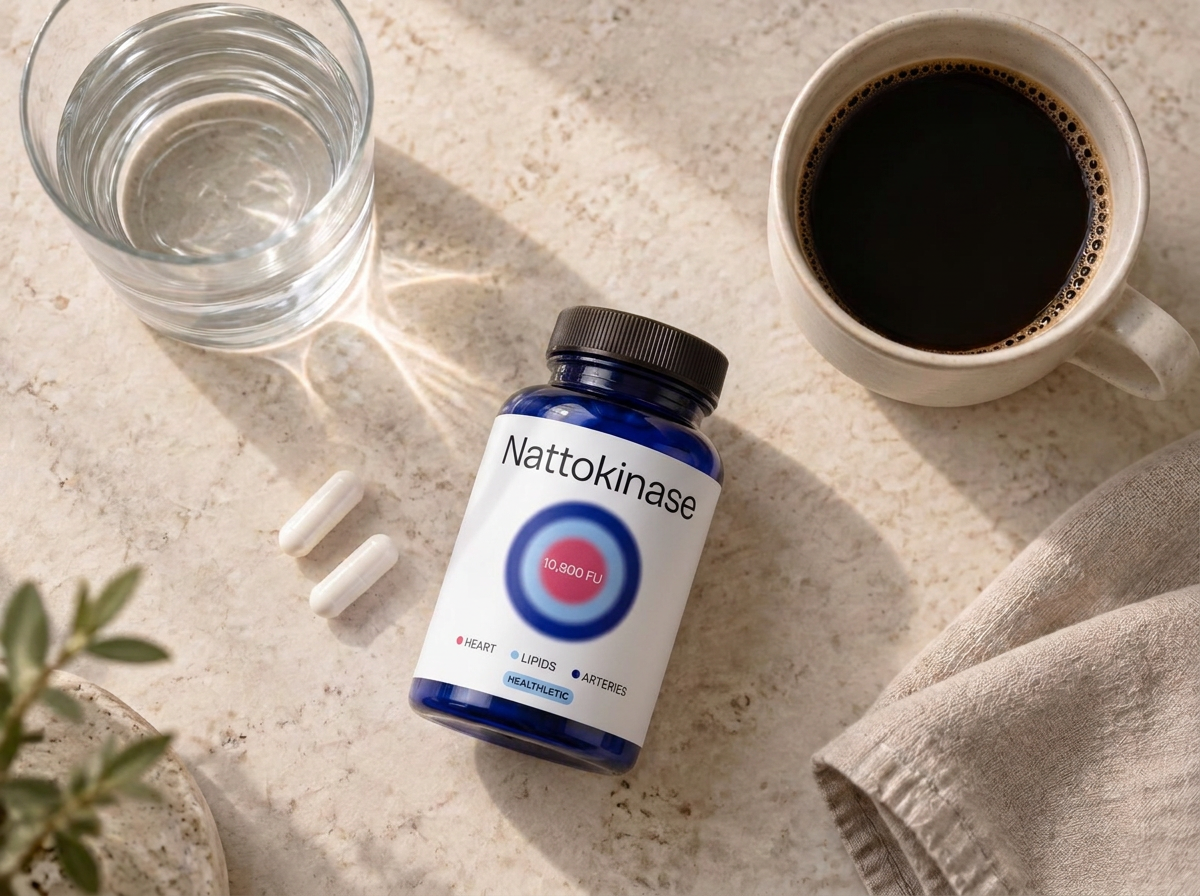
That's really the entire ritual.
And the more I learned, the stranger it seemed that nattokinase remained such a niche topic.
Most people I spoke with knew their cholesterol number.
They knew their blood pressure.
Some could tell me their LDL down to the exact point.
But mention fibrin or fibrinolysis, and you'd usually get a blank stare.
I would have given you the same blank stare once.
Now I think the concept deserves a place in the conversation.
Not because fibrin is some evil substance your body needs to “get rid of.”
That isn't true.
You need normal clotting.
You need fibrin.
What matters is balance.
And that's exactly why I think nattokinase is so interesting.
The more I learned, the more I kept thinking back to that first conversation.
“If my numbers are better, why don’t I feel better?”
I see that question very differently now.
If You've Been Thinking About Your Circulation Differently Lately…

Maybe your hands and feet don't feel as warm as they once did.
Maybe your stamina isn't what it used to be.
Maybe cardiovascular health has simply become something you pay more attention to now than you did at 30.
You don't need to panic.
And you don't need to throw out what your doctor has told you.
But you may want to learn more about the system most people never hear about:
Fibrinolysis.
And the enzyme researchers discovered inside a traditional Japanese food.
Because that's where my own curiosity started.
And it completely changed what I look for in a cardiovascular supplement.
So if you're going to try nattokinase, I'd pay attention to the same things that stood out to me in the research.
If you want to see the exact formula I ended up choosing after looking into all of it, you can take a look at Healthletic’s official website here.